Year 12: Component 1 (Foundation skills) Students work through a series of experimental workshops designed to develop technical skill and knowledge of new media for the first two terms. Students then progress to a more independent way of working, selecting media to investigate further and developing personal responses to a theme, for example ‘A Sense of Place’. The practical work will be informed by critical research and investigations into the work of professional artists and designers. The work students produce will be refined and organised into a portfolio which will demonstrate skills in the four assessment objectives; develop, experiment and refine, record observations, and present. Students will be pushed technically and creatively to respond to the theme in new and imaginative ways. Year 13, A Level: Component 1 (Personal Investigation) Portfolio including a personal study, 60% of A Level marks: Students are guided through the writing of a research question, tailored to their interests, to respond to in their portfolios. Students then work through a series of experimental workshops designed to develop technical skill and knowledge of new media in response to their research question. They learn to interpret art work in a more meaningful way, investigating key periods or themes of art and design history and learn to critically analyse artwork. Students select their preferred media and refine their practice, developing their own style and ways of working. They present their practical work which is assessed against the four assessment objectives; develop, experiment and refine, record observations, and present. A supporting essay (1000-3000 words) which provides a critical analysis of their work is also presented for assessment. Component 2: Exam, 40% of A Level marks: Students develop a personal response to an exam question, the exam concludes with a 15 hour practical piece. All the work they produce is assessed against the four assessment objectives.
• A minimum of five GCSE grades 9 to 5, with at least grade 5 in English and Mathematics. • If destination is Architecture, Art typically is taken with Mathematics and/or Physics. • GCSE grade 6 in Art or Photography
1. Personal Investigation 60% A body of work covering the Assessment Objectives with final outcomes in 2 and 3 dimensions. Assessment Objectives – Required skills and knowledge: AO1: Develop ideas through a sustained and focused investigation informed by contextual and other sources, demonstrating analytical and critical understanding. AO2: Explore and select appropriate resources, media, materials, techniques and processes, reviewing and refining ideas as work develops. AO3: Record ideas, observations and insights relevant to intentions, reflecting critically on work and progress. AO4: Present a personal and meaningful response that realizes intentions, and where appropriate, make connections between visual and other elements. In addition, one 3,000 word essay accompanies the practical work. 2. Exam 40% This paper will be given early February, in advance of the exam. The theme is set externally.
About Education Provider
| Region | South East |
| Local Authority | Surrey |
| Ofsted Rating | Outstanding |
| Gender Type | Co-Educational |
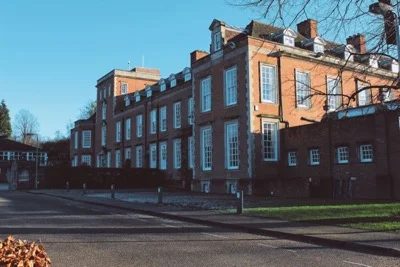
| Address | Bagshot Road, West End, Woking, GU24 9PT |
Year 12: Component 1 (Foundation skills) Students work through a series of experimental workshops designed to develop technical skill and knowledge of new media for the first two terms. Students then progress to a more independent way of working, selecting media to investigate further and developing personal responses to a theme, for example ‘A Sense of Place’. The practical work will be informed by critical research and investigations into the work of professional artists and designers. The work students produce will be refined and organised into a portfolio which will demonstrate skills in the four assessment objectives; develop, experiment and refine, record observations, and present. Students will be pushed technically and creatively to respond to the theme in new and imaginative ways. Year 13, A Level: Component 1 (Personal Investigation) Portfolio including a personal study, 60% of A Level marks: Students are guided through the writing of a research question, tailored to their interests, to respond to in their portfolios. Students then work through a series of experimental workshops designed to develop technical skill and knowledge of new media in response to their research question. They learn to interpret art work in a more meaningful way, investigating key periods or themes of art and design history and learn to critically analyse artwork. Students select their preferred media and refine their practice, developing their own style and ways of working. They present their practical work which is assessed against the four assessment objectives; develop, experiment and refine, record observations, and present. A supporting essay (1000-3000 words) which provides a critical analysis of their work is also presented for assessment. Component 2: Exam, 40% of A Level marks: Students develop a personal response to an exam question, the exam concludes with a 15 hour practical piece. All the work they produce is assessed against the four assessment objectives.
• A minimum of five GCSE grades 9 to 5, with at least grade 5 in English and Mathematics. • If destination is Architecture, Art typically is taken with Mathematics and/or Physics. • GCSE grade 6 in Art or Photography
1. Personal Investigation 60% A body of work covering the Assessment Objectives with final outcomes in 2 and 3 dimensions. Assessment Objectives – Required skills and knowledge: AO1: Develop ideas through a sustained and focused investigation informed by contextual and other sources, demonstrating analytical and critical understanding. AO2: Explore and select appropriate resources, media, materials, techniques and processes, reviewing and refining ideas as work develops. AO3: Record ideas, observations and insights relevant to intentions, reflecting critically on work and progress. AO4: Present a personal and meaningful response that realizes intentions, and where appropriate, make connections between visual and other elements. In addition, one 3,000 word essay accompanies the practical work. 2. Exam 40% This paper will be given early February, in advance of the exam. The theme is set externally.